

Why the next frontier of agentic customer experience is turning customer signals into operational intelligence and action.
Imagine a customer contacting a company because an order has not arrived.
An intelligent virtual agent identifies the issue, checks the delivery status, provides an update, and perhaps initiates an appropriate service recovery process. The customer receives an answer without waiting for a human representative.
From a customer service perspective, this is progress.
But what happens when hundreds of customers experience the same delivery problem? What if the underlying issue is a recurring inventory discrepancy, an unreliable logistics partner, or a breakdown between order fulfillment and customer communication?
The virtual agent may resolve each individual interaction successfully while the underlying problem continues to affect thousands of customers.
As organizations accelerate their investment in agentic AI, this distinction is becoming increasingly important.
The next competitive advantage in customer experience will not come from AI that can simply answer more questions. It will come from AI that helps organizations understand what is happening across customer journeys, identify the causes of recurring problems, and coordinate meaningful action.
The Agentic AI Execution Gap
The enterprise AI market is approaching an important turning point.
According to Frost & Sullivan's Frost Radar™: Intelligent Virtual Agents for Customer Experience, 2026, 57% of organizations identify AI as their leading technology investment priority. Yet only 12% have deployed agentic AI across multiple enterprise use cases.
The gap is not simply between organizations adopting AI and those that have yet to do so. It is between experimenting with intelligent technologies and integrating them into how a business operates.
Research from McKinsey's State of AI in 2026 reinforces this distinction. While adoption continues to expand, only 37% of respondents report that AI has contributed to their organization's earnings before interest and taxes (EBIT). Organizations generating the strongest results tend to redesign workflows rather than simply add AI to existing processes.
For customer experience leaders, the implications are significant.
A virtual agent can automate a conversation. An AI assistant can summarize customer feedback. An analytics engine can identify a decline in satisfaction.
But unless these capabilities connect to operational responsibility, coordinated execution, and measurable outcomes, much of their business potential remains unrealized.
This is the execution gap that CX organizations must address.
Why Smarter Customer Interactions Are Only Half the Equation
Intelligent Virtual Agents (IVAs) are transforming how organizations interact with customers.
Unlike traditional rule-based chatbots, modern IVAs can interpret intent, maintain conversational context, retrieve information from enterprise systems, and execute increasingly complex tasks.
These capabilities improve accessibility and make it possible to resolve more customer requests without human intervention.
Yet customer experience management involves more than responding to individual requests.
Consider three challenges that remain even when customer-facing automation works as intended.
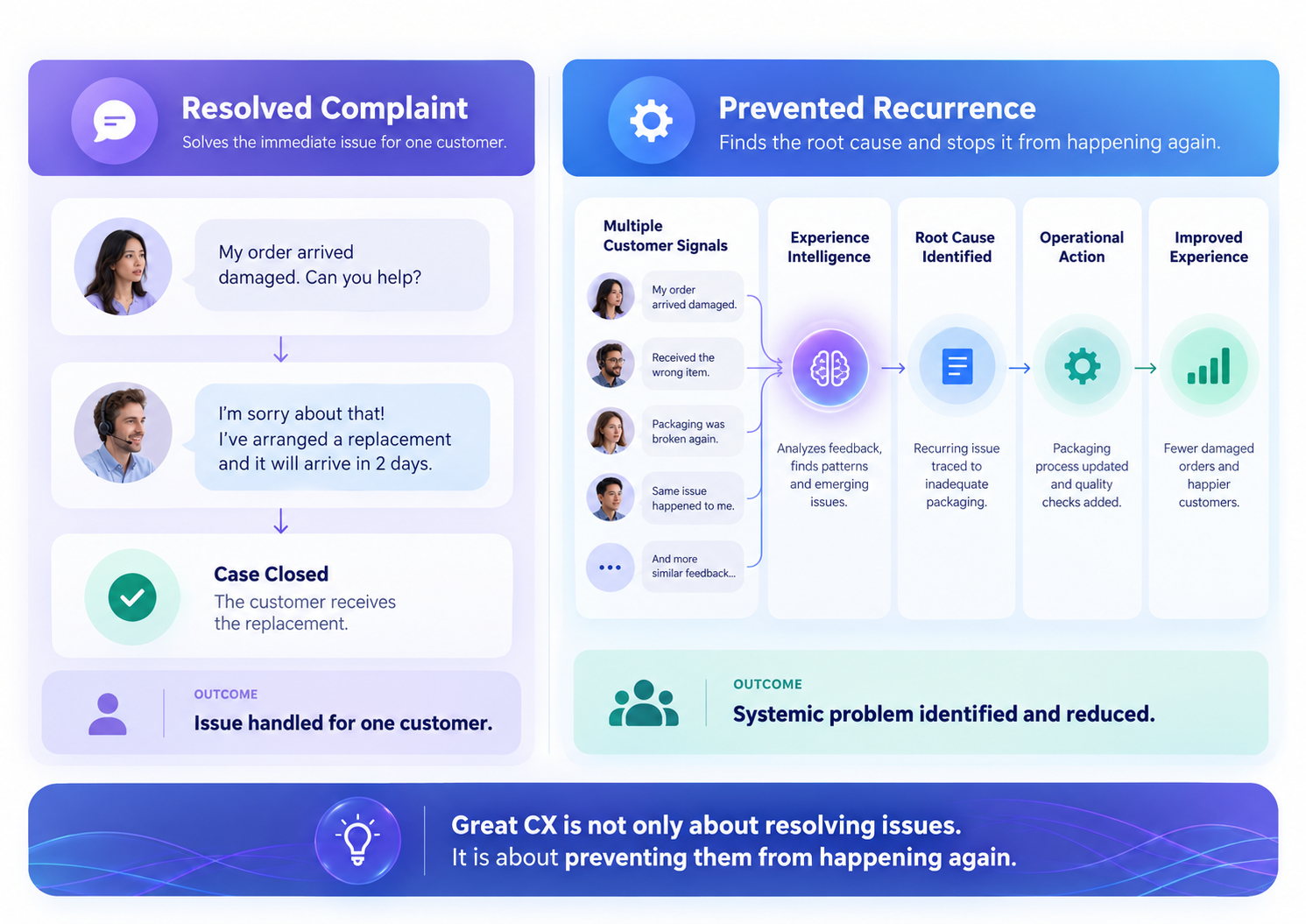
1. A resolved interaction does not necessarily mean a resolved problem
A customer receives an explanation for an unexpected bank fee. Another customer reports the same confusion the following day. A third contacts the support center because the fee was not communicated clearly during onboarding.
Each interaction may be resolved individually.
However, the organization may still lack visibility into the recurring communication problem behind them.
To improve the experience, it must connect these interactions, recognize the pattern, determine the underlying cause, and assign responsibility for preventing it from recurring.
2. Customer experience signals extend far beyond conversations
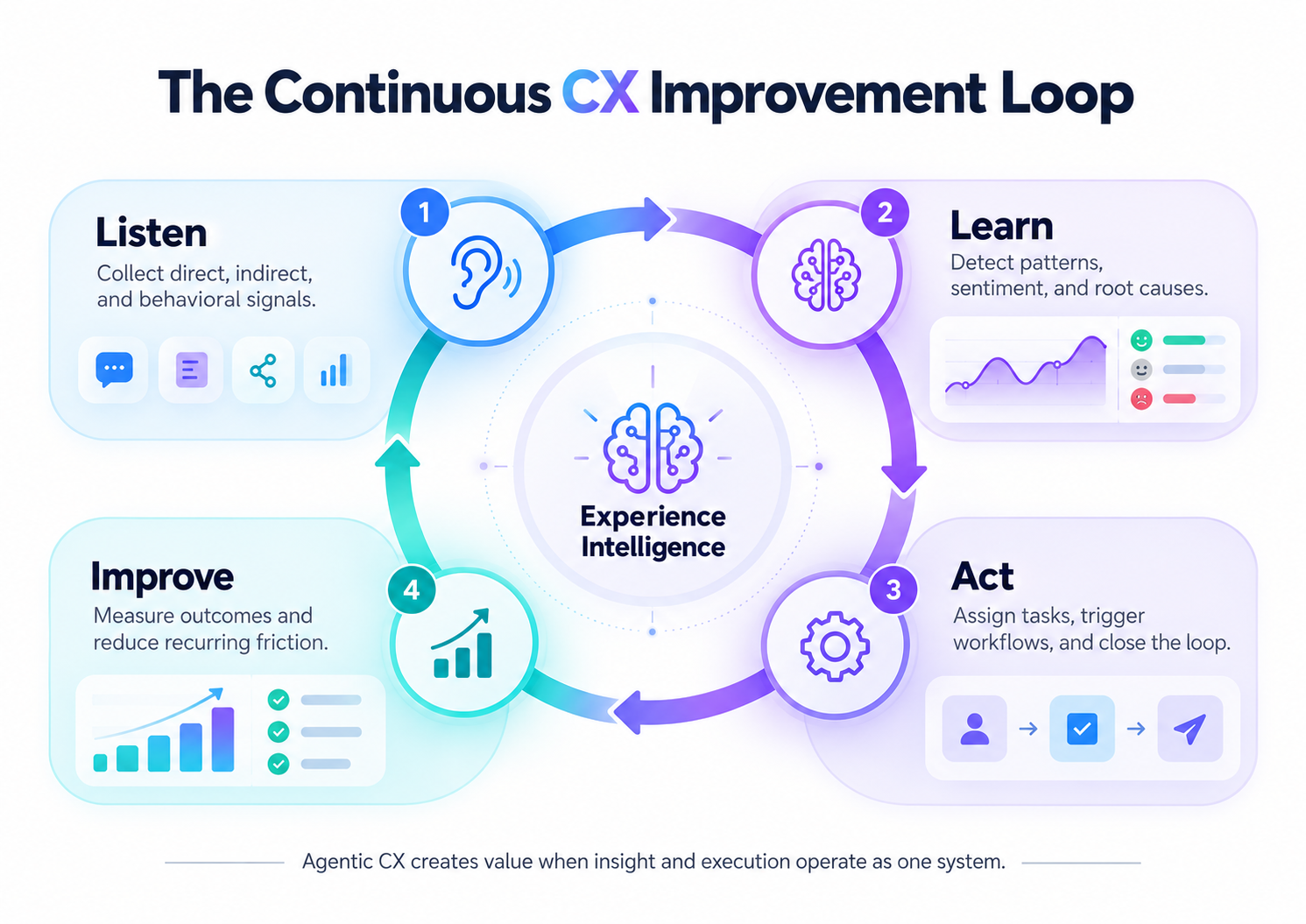
Customers communicate their experiences in many ways.
Some respond to surveys. Others submit complaints, leave public reviews, abandon digital journeys, contact support multiple times, or simply stop using a service.
These signals frequently exist in different systems.
A contact center may understand the reasons behind incoming calls. A digital team may identify abandoned transactions. A CX team may observe declining CSAT. An operations team may see increasing service failures.
Each team holds part of the picture.
The challenge is to connect these signals into a shared understanding of the customer experience.
3. Insight without ownership rarely creates lasting improvement
Even when an organization identifies a problem, an important question remains:
Who is responsible for fixing it?
A decline in NPS may be visible to the CX team, but its root cause could sit in billing, fulfillment, product development, branch operations, or customer onboarding.
Without clear ownership, escalation mechanisms, and follow-up processes, insights can remain trapped in dashboards and presentations.
The missing layer is not necessarily more intelligence. It is the ability to connect intelligence with execution.
From Customer Signals to Operational Intelligence
For agentic AI to generate meaningful value in experience management, organizations need an operating model that connects customer understanding with business action.
This requires a continuous cycle of listening, learning, acting, and measuring results.
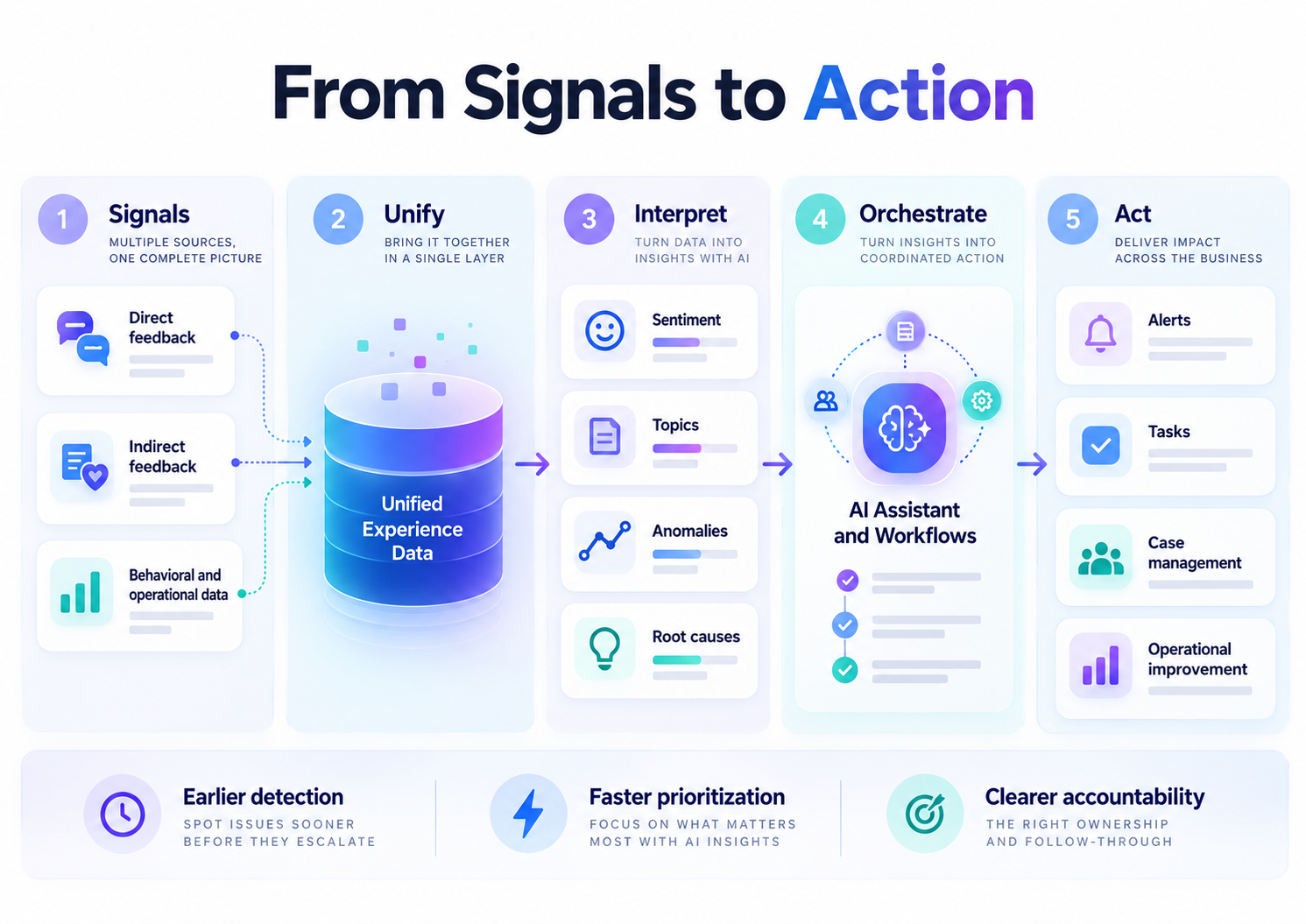
Listen: Understand the complete experience, not just survey responses
Modern Voice of Customer programs must extend beyond traditional feedback collection.
Direct feedback, including surveys and complaints, remains valuable. But indirect signals from public reviews, support interactions, and other customer communications can reveal problems that structured feedback alone may miss.
Behavioral and operational data provide another layer of context.
A customer who repeatedly encounters a failed digital transaction may never submit a complaint. Yet the interaction itself may indicate friction.
Combining direct, indirect, and inferred experience signals creates a more comprehensive foundation for understanding customer needs.
Learn: Turn fragmented information into actionable intelligence
The next step is identifying what the signals collectively reveal.
AI-powered experience analytics can help organizations recognize emerging themes, interpret sentiment, detect anomalies, and investigate potential root causes.
For example, a decline in customer satisfaction across several locations becomes more meaningful when connected to increasing delivery delays, transaction failures, or support waiting times.
Instead of asking only what customers are saying, organizations can begin asking:
- What has changed in the customer experience?
- Which customers or journeys are most affected?
- What is likely driving the change?
- Which issues need immediate attention?
- What operational response would create the greatest impact?
This is where AI can move from summarizing historical information toward supporting operational decisions.
Act: Connect intelligence with accountable execution
Insights become valuable when they influence what happens next.
An identified issue may need to trigger an operational alert, generate a task, initiate a service recovery workflow, or escalate a recurring problem to the relevant business owner.
Some actions can be automated according to predefined rules. Others require human judgment, particularly where customer rights, financial decisions, sensitive information, or regulatory obligations are involved.
The objective is not automation for its own sake.
It is to ensure that the right issue reaches the right team, with the right context, at the right time.
Learn again: Measure whether the action worked
Closing an operational task is not the same as improving the customer experience.
Organizations must also understand whether their actions have reduced friction, prevented recurrence, improved satisfaction, or strengthened retention.
This creates a continuous improvement cycle in which customer signals inform decisions, decisions trigger actions, and their outcomes generate new learning.
At enterprise scale, this cycle must operate across journeys, teams, locations, and business units.
What Does Agentic Experience Management Look Like in Practice?
The opportunity becomes clearer when applied to everyday business situations.
The following examples are illustrative scenarios, showing how connected experience intelligence and AI-supported workflows could transform common CX challenges.
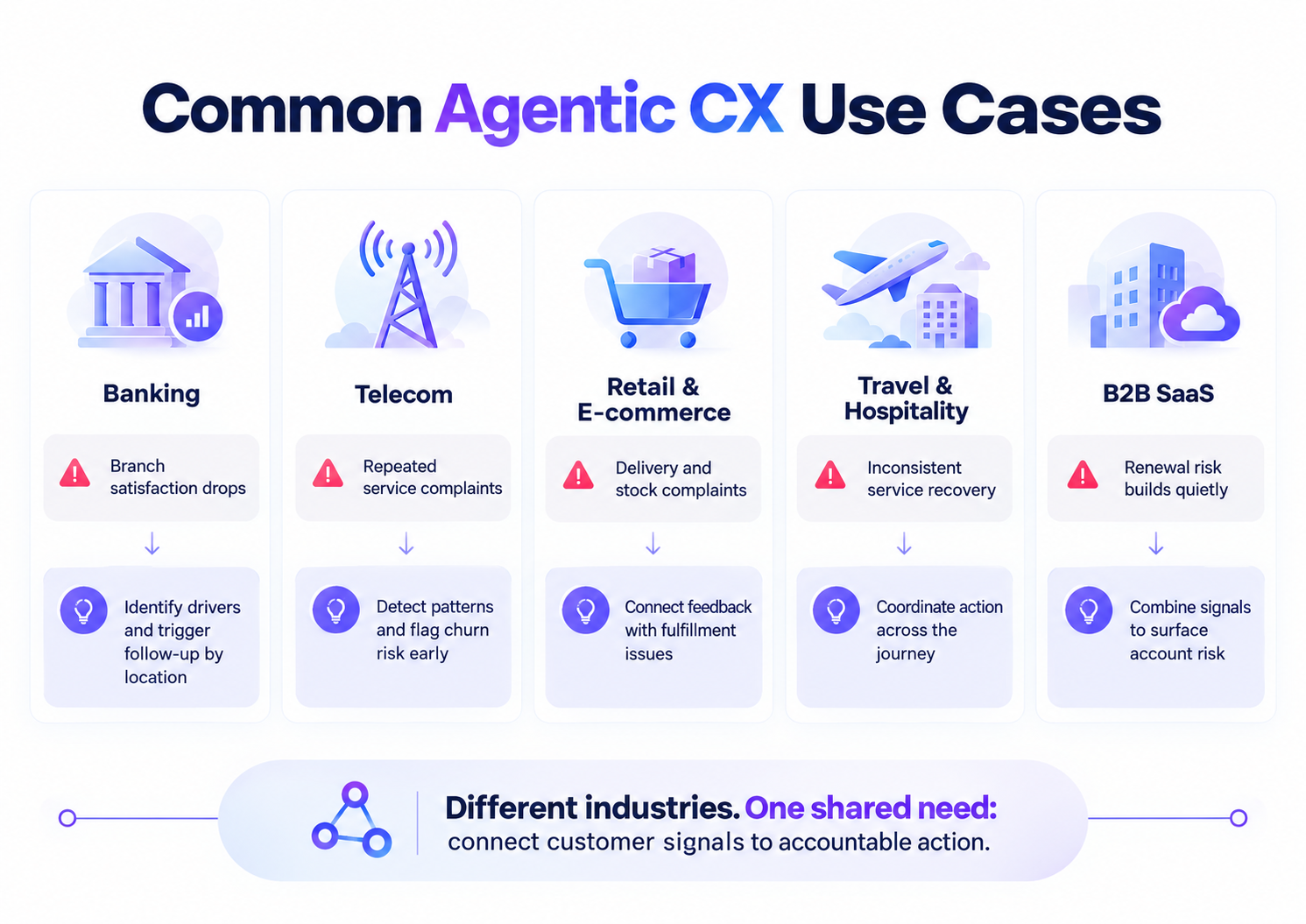
Banking: Detecting the real problem behind declining branch satisfaction
A financial institution notices that customer satisfaction has declined across several branches.
Traditionally, the CX team might examine survey reports, compare branch performance, and manually investigate complaints.
In a more connected environment, AI could analyze feedback alongside operational information, identify recurring themes, and reveal that customers are increasingly dissatisfied with appointment waiting times.
It could then support the generation of a branch-level report, highlight the most affected locations, and recommend operational follow-up.
Authorized users could create tasks for branch managers, track corrective actions, and monitor subsequent satisfaction trends.
Telecommunications: Connecting repeated complaints with churn risk
A telecom operator receives growing numbers of complaints about intermittent connectivity.
Customer-facing virtual agents may help subscribers troubleshoot individual incidents. However, resolving these conversations does not automatically reveal whether particular customer segments are experiencing repeated service failures.
By connecting service feedback, support interactions, network incident information, and customer journey context, the operator could identify recurring dissatisfaction patterns.
AI-supported analysis could highlight affected customer groups, flag emerging churn indicators, and direct attention toward the operational issues contributing to dissatisfaction.
CX, network operations, and retention teams could then coordinate appropriate interventions and evaluate their impact.
Retail and E-commerce: Discovering the cause of recurring delivery complaints
An e-commerce retailer receives increasing negative feedback about delayed deliveries and products shown as available that cannot actually be fulfilled.
Customer support teams may resolve individual complaints through status updates, refunds, or replacement orders.
But the underlying issue may involve inconsistent inventory synchronization across warehouses and sales channels.
An experience intelligence system could identify the emergence of stock availability as a recurring complaint category, compare satisfaction trends across delivery channels, and connect the pattern with relevant operational information.
Instead of treating each complaint as an isolated service case, the organization could initiate a broader investigation involving fulfillment, inventory management, and digital commerce teams.
AI could also assist in monitoring whether subsequent operational changes reduce complaint recurrence.
Travel and Hospitality: Coordinating service recovery across the journey
A traveler encounters a delay, receives inconsistent information, and later submits negative feedback about the experience.
The immediate service issue may already have been addressed.
However, similar complaints across locations, routes, or service teams may indicate a wider coordination problem.
By connecting feedback with journey stages, service events, and operational ownership, AI could help distinguish isolated incidents from emerging systemic issues.
The organization could identify the most affected touchpoints, prioritize operational follow-up, and monitor whether recovery actions improve subsequent customer experiences.
Where compensation or other consequential decisions are involved, authorized employees would retain the appropriate approval responsibilities.
B2B Services and SaaS: Identifying relationship risks before renewal
In B2B environments, customer dissatisfaction may develop gradually.
A customer account may show declining product adoption, repeated support escalations, unresolved onboarding issues, and increasingly negative stakeholder feedback.
Individually, these signals may appear manageable.
Together, they may indicate a broader relationship risk.
An integrated experience management approach could connect these signals at the account level, summarize emerging concerns, and help account owners prioritize engagement.
AI-supported reporting could also surface recurring issues across similar customer segments, helping product, customer success, and operations teams identify opportunities for improvement.
The same principle extends to employee experience. Organizations can connect employee feedback with operational context to detect workplace friction, route issues to responsible teams, and track whether improvement initiatives address the underlying concerns.
Across these examples, the industries and operational workflows differ.
The fundamental requirement remains the same: connect experience signals, understand their significance, and translate them into accountable action.
The Emerging Role of AI-Powered Experience Management Assistants
As experience management becomes more operationally integrated, the role of AI within CX platforms is also evolving.
AI is no longer limited to helping analysts interpret charts or summarize open-text feedback.
Its expanding role includes assisting users with operational analysis, generating reports through natural-language requests, identifying unusual trends, recommending actions, and supporting workflow execution.
This is the direction behind Pisano Leo, the AI-Powered XM Assistant.
Pisano's approach to experience management already emphasizes the connection between feedback collection, experience analytics, journey intelligence, case management, and operational workflows.
Leo builds on this foundation as an intelligence and orchestration layer for experience management teams.
Its product direction focuses on making complex CX activities easier to initiate, interpret, and execute.
Consider a CX manager asking:
"What changed in customer satisfaction across our branches last week?"
An AI-powered XM assistant can help turn this question into a targeted analysis, bringing relevant metrics, feedback themes, and operational context together.
The next step is moving from insight assistance to more connected operational workflows.
The roadmap for Leo explores capabilities such as natural-language report generation, assisted survey and flow creation, anomaly explanation, what-if scenario analysis, and the initiation of controlled workflow tasks.
For example, a manager might want to investigate a sudden CSAT decline, examine the affected branches, understand potential contributing factors, and initiate follow-up actions without moving manually between multiple reporting and workflow environments.
More advanced scenario analysis could help teams explore the potential impact of proposed improvements before deciding where to allocate resources.
These capabilities represent a broader product evolution toward AI-supported operational orchestration, with individual functions introduced according to their development and availability.
Importantly, Leo's role is distinct from that of a customer-facing virtual agent.
While IVAs focus primarily on understanding and resolving customer interactions, an AI-powered XM assistant focuses on helping the organization understand and improve the experiences those interactions reveal.
One helps resolve the customer's immediate issue. The other helps the organization learn what needs to change.
Together, these capabilities point toward a more connected model of customer experience management.
Why Governance Matters More as AI Gains Operational Responsibility
Expanding AI from analysis into execution creates substantial opportunity. It also raises important questions about trust, accountability, and operational control.
Not every action should be autonomous.
An AI assistant may be authorized to prepare a report, recommend a workflow, or identify an anomaly. Modifying organizational permissions, initiating consequential customer actions, or changing sensitive operational settings may require additional controls.
This distinction is particularly important for enterprises operating across regulated industries, multiple countries, or complex organizational structures.
In its October 2026 analysis, Gartner emphasizes that successful AI agent adoption depends on reliability, accountability, and governance, rather than maximizing autonomy without sufficient safeguards.
For experience management, responsible AI adoption should include role-based permissions, traceable actions, transparent operational ownership, and appropriate human oversight.
Organizations should also evaluate data quality, integration reliability, and the potential consequences of automated actions.
Autonomy should expand as reliability and organizational confidence improve.
A well-designed agentic operating model does not eliminate human accountability. It gives people better intelligence, faster execution capabilities, and clearer control over the actions taken.
Measuring the Real Business Value of Agentic CX
The success of AI-powered experience management should not be measured only by the number of interactions automated or reports generated.
These indicators can demonstrate efficiency, but they do not necessarily prove that the customer experience has improved.
A more meaningful measurement framework connects AI activity with operational and business outcomes.
Organizations can evaluate how quickly they detect emerging problems, how long it takes to assign and complete corrective actions, and whether recurring issues decline after intervention.
They can also examine changes in customer satisfaction, repeat-contact rates, customer effort, retention, and the operating cost of resolving experience-related problems.
The answers to these questions will determine whether agentic AI becomes a meaningful business capability or remains another layer of technology.
The Future of Customer Experience Is a Business That Continuously Learns
Intelligent virtual agents are advancing rapidly. Their ability to understand customer intent, maintain context, and execute tasks is already changing expectations for digital service.
But the greater opportunity extends beyond individual interactions.
Every customer complaint, support conversation, survey response, service failure, or behavioral signal can potentially contribute to a broader understanding of the customer experience.
The real transformation begins when organizations can connect these signals, identify meaningful patterns, and translate intelligence into coordinated operational improvement.
This requires more than sophisticated AI models.
It requires connected data, well-designed workflows, clear accountability, governance, and a continuous relationship between listening, learning, and acting.
For CX leaders, the strategic question is no longer simply how many customer interactions AI can automate.
It is how effectively AI can help the organization understand what customers are experiencing and improve what happens next.
The future of customer experience is not an AI agent that can answer every question. It is an organization that can learn and act on what every interaction reveals.