

A telecom network can be performing exactly as expected while its customers experience something entirely different.
A mobile subscriber struggles to complete a video call in a crowded train station, even though network availability indicators remain within acceptable thresholds. A business customer receives the connectivity promised in their service agreement but spends days trying to resolve an invoicing issue. A broadband customer finally gets an installation problem fixed, yet remembers the repeated appointments more vividly than the eventual resolution.
From an operational perspective, these situations may involve separate systems and teams. From the customer's perspective, they all contribute to one experience.
This distinction is becoming increasingly important as telecom operators compete in markets where connectivity is essential, service offerings are becoming harder to differentiate, and customer expectations continue to rise.
According to Ericsson ConsumerLab's research on 5G performance and loyalty, consumers experiencing connectivity problems at locations such as airports and event venues were three times more likely to indicate a risk of switching providers within six months.
The research highlights an important reality. Network performance matters, but the value customers associate with connectivity depends on how consistently it works in the situations that matter to them.
For telecom leaders, this raises a broader question.
How can an organization understand the experience customers actually have, including the moments they never report, and turn that understanding into meaningful operational improvements?
The answer requires a more connected approach to Experience Management.
Why Telecom Customer Experience Is Different
Few industries manage customer relationships across as many interconnected operational environments as telecommunications.
A single customer may interact with an operator through a mobile application, retail store, contact center, installation technician, billing system, and network infrastructure within the same month.
Each interaction contributes to the customer's perception of the brand. Yet the information generated by these interactions often remains distributed across separate systems and departments.
Consider a common broadband customer journey.
A customer purchases a new service online. The order triggers provisioning activities, followed by an installation appointment. After activation, the customer uses the service regularly, receives invoices, and occasionally contacts support.
The commercial team may measure acquisition conversion. The installation team monitors appointments and service activation. Network operations track technical performance. Customer service measures ticket resolution. The CX team monitors satisfaction.
All these measures are important.
However, none necessarily explains whether the customer experienced the overall journey as simple, reliable, and worth recommending.
This creates three fundamental challenges for telecom Experience Management.
1. Operational Performance Does Not Always Reflect Perceived Experience
Technical metrics describe how infrastructure and systems perform. Customer experience metrics describe how people perceive the service delivered through them.
The two are related, but they are not interchangeable.
A network may achieve its availability target while customers in particular locations experience recurring congestion. A service incident may be resolved within the defined SLA, yet the customer may remain dissatisfied because communication was poor or the issue occurred repeatedly.
Understanding these differences requires operators to connect technical performance with customer feedback at relevant locations, moments, and journey stages.
2. Customer Journeys Cross Organizational Boundaries
Customers rarely distinguish between the departments responsible for their problems.
When an installation is delayed, they experience a broken promise. When an invoice is confusing, they experience unnecessary effort. When a complaint moves between teams, they experience an organization that struggles to take ownership.
A mature CX program must therefore operate across departments rather than simply aggregate departmental satisfaction scores.
3. Traditional Listening Programs Reveal Only Part of the Customer Base
Telecom operators may collect substantial amounts of feedback through NPS, CSAT, relationship surveys, transactional surveys, and digital channels.
However, even a well established Voice of Customer program primarily captures the opinions of customers who choose to respond.
The remaining customers continue using services, experiencing problems, changing their behavior, and making purchasing decisions without necessarily explaining how they feel.
This creates one of the most important opportunities for the next stage of telecom CX.
The Silent Majority: Understanding Customers Who Never Complete a Survey
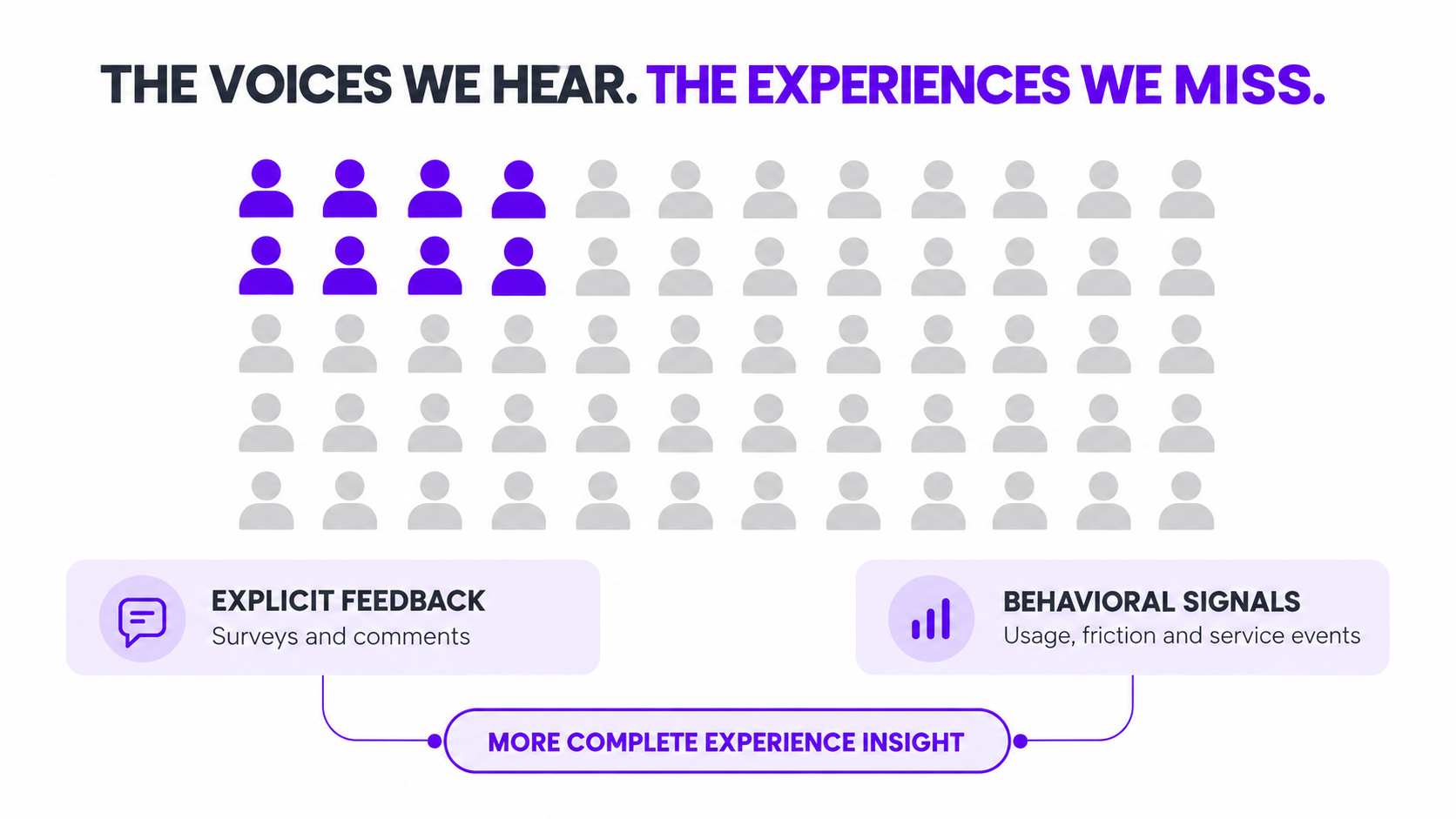
Every CX leader knows that customer feedback is valuable.
The more difficult question is whether the customers providing that feedback adequately represent the population whose experience the organization wants to improve.
Survey participation is rarely random. Customers may respond because they have particularly positive or negative experiences, because they have more time, or because the feedback request reaches them through their preferred channel.
Other customers may ignore invitations repeatedly, abandon surveys, or simply interact with the brand without being asked for feedback.
Their silence does not automatically indicate satisfaction.
Nor does it necessarily indicate dissatisfaction.
What matters is that their experiences may differ systematically from those of customers who respond.
Looking Beyond Explicit Feedback
Telecom operators already hold many signals that can help explain customer experiences beyond surveys.
These may include:
- Service usage patterns: Changes in data consumption, service adoption, or the frequency of specific activities.
- Network experience: Connectivity interruptions, performance degradation, congestion, and repeated technical incidents.
- Digital behavior: Abandoned transactions, failed self service attempts, repeated application errors, and unsuccessful searches for support.
- Customer service history: Repeat contacts, unresolved complaints, escalation frequency, and service recovery outcomes.
- Relationship signals: Contract renewal behavior, changes in account activity, product downgrades, and cancellation requests.
Individually, these signals provide limited context. Together, they can help operators identify patterns that deserve further investigation.
For example, a customer may never complete an NPS survey but may repeatedly experience failed digital transactions, contact support multiple times, and subsequently reduce their service usage.
These observations do not establish how that customer would answer an NPS question. They do, however, provide evidence of potential friction that the organization should investigate.
From Survey Response Rates to Experience Representation
This is where approaches such as Voice of Silent can extend traditional Experience Management.
By combining behavioral and operational signals with observed customer feedback, statistical models can help estimate experience risks among customers who do not respond.
An effective approach should distinguish between actual feedback and model predictions, validate predictions against representative samples, and regularly evaluate whether particular customer segments remain underrepresented.
Predictive results should support decisions without being presented as directly observed NPS or CSAT.
The goal is to make the organization's understanding of customer experience more representative, identify risks earlier, and allocate attention more intelligently.
For telecom operators managing millions of customer interactions, this represents a meaningful evolution in how listening programs can operate.
Connecting Network Intelligence with Customer Perception
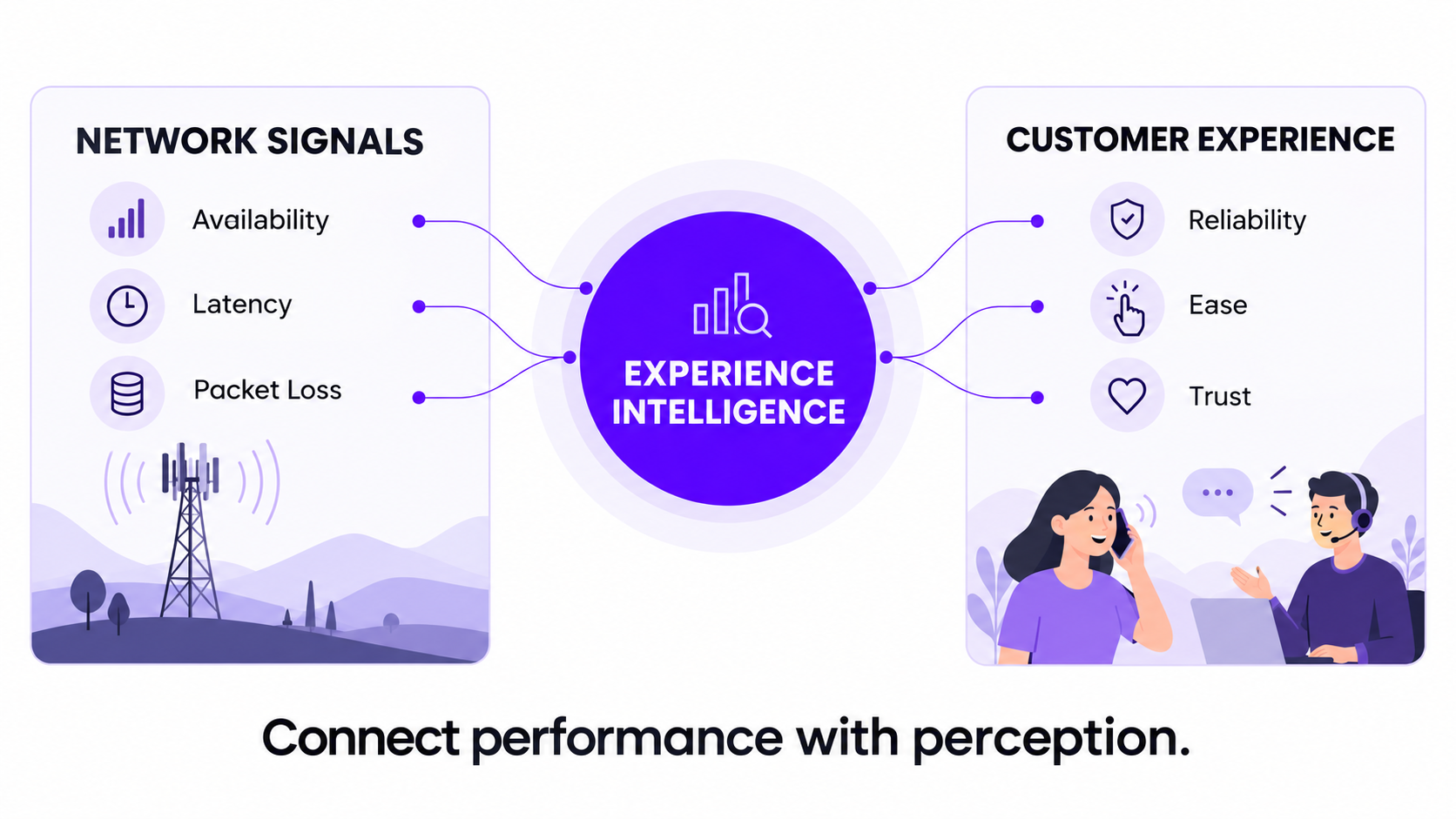
Telecommunications organizations have invested heavily in monitoring network performance.
Network operations teams track measures such as availability, latency, packet loss, throughput, and service interruptions. These metrics remain fundamental to reliable connectivity.
However, technical monitoring and customer perception often operate as separate disciplines.
A better model connects them.
Why the Same Network Issue Can Produce Different Customer Experiences
Imagine two subscribers experiencing similar network degradation.
One is streaming music during a short commute. The other is participating in an important video conference.
Although their underlying technical conditions may be similar, the perceived consequences can be very different.
A third customer may experience no technical failure but struggle to understand the service configuration or the information provided by customer support.
This illustrates why a network metric alone cannot fully explain satisfaction.
A useful Experience Management program should connect network information with customer context, including service type, location, usage behavior, recent interactions, and expressed feedback.
The resulting analysis can help answer questions such as:
- Which technical issues have the strongest relationship with customer dissatisfaction?
- Where does perceived network quality differ from measured network performance?
- Which service interruptions affect customer segments with greater retention risk?
- Are repeated complaints concentrated around certain locations, service types, or customer journeys?
- Which operational improvements produce measurable changes in customer perception?
The objective is to identify the relationship between service performance and customer experience, rather than assume that one automatically explains the other.
A Shift Toward Experience Driven Service Assurance
The industry is already moving in this direction.
TM Forum's work on AI driven Service Operations Centers explores how operators can combine network monitoring with quality of experience indicators, customer complaints, and business risk signals.
This creates opportunities to move from reactive troubleshooting toward more proactive service assurance.
An Experience Management platform plays a complementary role in this architecture.
Network monitoring tools detect technical conditions. Experience intelligence helps determine how those conditions affect customers, which issues deserve attention, and whether the actions taken improve the experience.
Connecting these disciplines brings operators closer to understanding the actual customer impact of their operational decisions.
B2B Telecom Experience Requires a Different Measurement Model
Consumer experience is only one part of the telecom landscape.
Enterprise customers represent complex relationships involving multiple stakeholders, services, contracts, and operational dependencies.
A single enterprise account may have numerous locations, hundreds of employees, several connectivity products, and different decision makers responsible for technology, procurement, finance, and operations.
Measuring such relationships through a conventional consumer survey model creates important limitations.
One Enterprise Account, Multiple Experiences
Consider a company using a telecom operator for connectivity across its offices.
The CIO may evaluate reliability, technical capability, and strategic partnership.
The procurement director may care primarily about commercial transparency and contract flexibility.
The IT operations team may focus on incident resolution, technical support, and service stability.
Employees using the services may judge the operator through everyday connectivity quality.
All these perspectives matter, but they should not necessarily carry the same meaning or weight in relationship measurement.
A robust B2B experience framework should therefore distinguish between relationship health and transactional experience.
Relationship measurement examines the overall partnership, strategic value, trust, and likelihood of renewal or recommendation.
Transactional measurement captures experiences at specific moments, such as onboarding, service activation, technical support, incident resolution, and billing.
Both can contribute to an account level view, provided the methodology defines how stakeholder roles, response volumes, and different types of feedback are interpreted.
Building an Account Health Perspective
A useful account health model connects relationship feedback with operational indicators.
These might include service disruption frequency, SLA performance, unresolved incidents, billing disputes, escalation history, and renewal related activity.
For example, an enterprise account may continue reporting acceptable relationship satisfaction while experiencing a rising number of technical escalations.
This combination deserves attention.
The account manager may have an opportunity to intervene before the operational difficulties develop into broader relationship dissatisfaction.
An effective B2B Experience Management program therefore requires collaboration between account management, service delivery, technical operations, and CX teams.
The shared objective is to protect the entire customer relationship, not simply improve a survey score.
Turning Experience Intelligence into Operational Action
Collecting more feedback rarely solves a customer experience problem on its own.
The value begins when an organization can identify what needs to change and ensure that the appropriate teams take responsibility.
This is particularly important in telecom, where an issue may involve several operational functions.
Consider a customer reporting repeated connectivity problems after receiving technical support.
A traditional listening process may capture a negative CSAT score and include it in the next reporting cycle.
A more operationally connected approach can initiate a different sequence.
The Inner Loop: Resolving Individual Customer Problems
The feedback triggers a case or updates an existing record. Relevant technical and customer information accompanies the case.
The responsible team receives an assignment based on the problem category, customer segment, and operational rules.
The organization tracks the response, escalation, and resolution process.
Once the issue is addressed, the team can verify whether the customer's problem has actually been resolved.
This creates accountability around an individual experience.
The Outer Loop: Fixing Problems That Keep Returning
Individual issue resolution is essential, but repeated complaints often indicate a structural problem.
Imagine that customers in several regions consistently report confusion about a particular invoice item.
Resolving each complaint separately may improve immediate satisfaction, but it does little to reduce the likelihood of future complaints.
Text analytics can help identify the recurring theme. Operational data can establish its frequency and associated support burden.
The billing, product, and CX teams can then investigate the underlying cause and redesign the relevant communication or process.
The improvement can be evaluated through subsequent complaint volumes, repeat contact rates, customer effort, and satisfaction.
This is where Experience Management starts supporting continuous operational improvement.
Five Telecom Journeys Where Connected Experience Management Can Create Value
The opportunity across these journeys is a consistent connection between experience signals, operational ownership, and measurable results.
Using AI to Make Experience Management More Proactive
Artificial intelligence creates opportunities to expand the scale and speed of customer experience analysis.
However, its most useful contribution is often much more practical than an impressive demonstration.
Consider a telecom CX team receiving thousands of open text comments from service interactions, surveys, digital applications, and support channels.
Manually reviewing this information may consume significant time, while important patterns remain difficult to identify.
AI powered text analytics can help categorize feedback, detect sentiment, recognize recurring themes, and highlight unusual changes across different customer groups.
An emerging billing issue can become visible before it generates a large volume of formal complaints. A sudden increase in negative feedback after a service change can prompt an investigation. A manager can examine the experiences affecting a particular region without waiting for a manually prepared report.
Generative AI assistants can also help users navigate reporting environments, summarize feedback, and explore potential causes of changing experience metrics.
Predictive Intelligence Needs Operational Context
As programs mature, predictive models can extend this approach further.
For example, combining historical satisfaction, service incidents, repeated contacts, and customer behavior may help identify accounts with increasing retention risk.
Similarly, analyzing the relationship between experience drivers and overall satisfaction can help CX leaders estimate which improvements may produce the greatest impact.
These capabilities become more valuable when organizations validate model outputs, monitor accuracy, and keep humans accountable for consequential decisions.
Predictions should guide investigation and prioritization. They should not replace direct evidence or customer communication.
The greatest opportunity lies in connecting AI supported insight with real operational workflows, allowing teams to respond to emerging risks while there is still an opportunity to improve the experience.
Measuring the Business Value of Telecom CX Beyond NPS
Net Promoter Score remains a useful indicator of customer loyalty and brand perception.
However, improving NPS should not be the only way a telecom operator evaluates the effectiveness of its Experience Management program.
A stronger measurement framework connects customer experience improvements with operational and commercial outcomes.
Customer Retention
Does addressing recurring service problems reduce cancellation behavior or improve renewal performance?
Retention analysis should consider customer segments, service history, and other factors that influence switching decisions.
Operational Efficiency
Do improvements in billing clarity, activation processes, or digital journeys reduce avoidable support interactions?
Tracking repeat contacts, average handling effort, and cost per interaction helps translate CX initiatives into operational value.
Service Recovery
Are customers receiving faster, more effective resolutions?
Resolution time matters, but so do repeat issues, successful closure, and customer satisfaction after the problem has been addressed.
Revenue Opportunities
Do customers with better experiences demonstrate stronger renewal, service adoption, or account expansion?
These relationships should be evaluated carefully, ideally using comparisons that help distinguish the impact of CX improvements from other commercial factors.
A practical business case can combine attributable cost savings with the estimated gross margin protected through retention or generated through additional business, then account for implementation and operating costs.
This helps CX leaders demonstrate how customer experience contributes to business performance while avoiding the assumption that every change in satisfaction directly causes revenue growth.
A Practical Roadmap for Telecom Experience Transformation
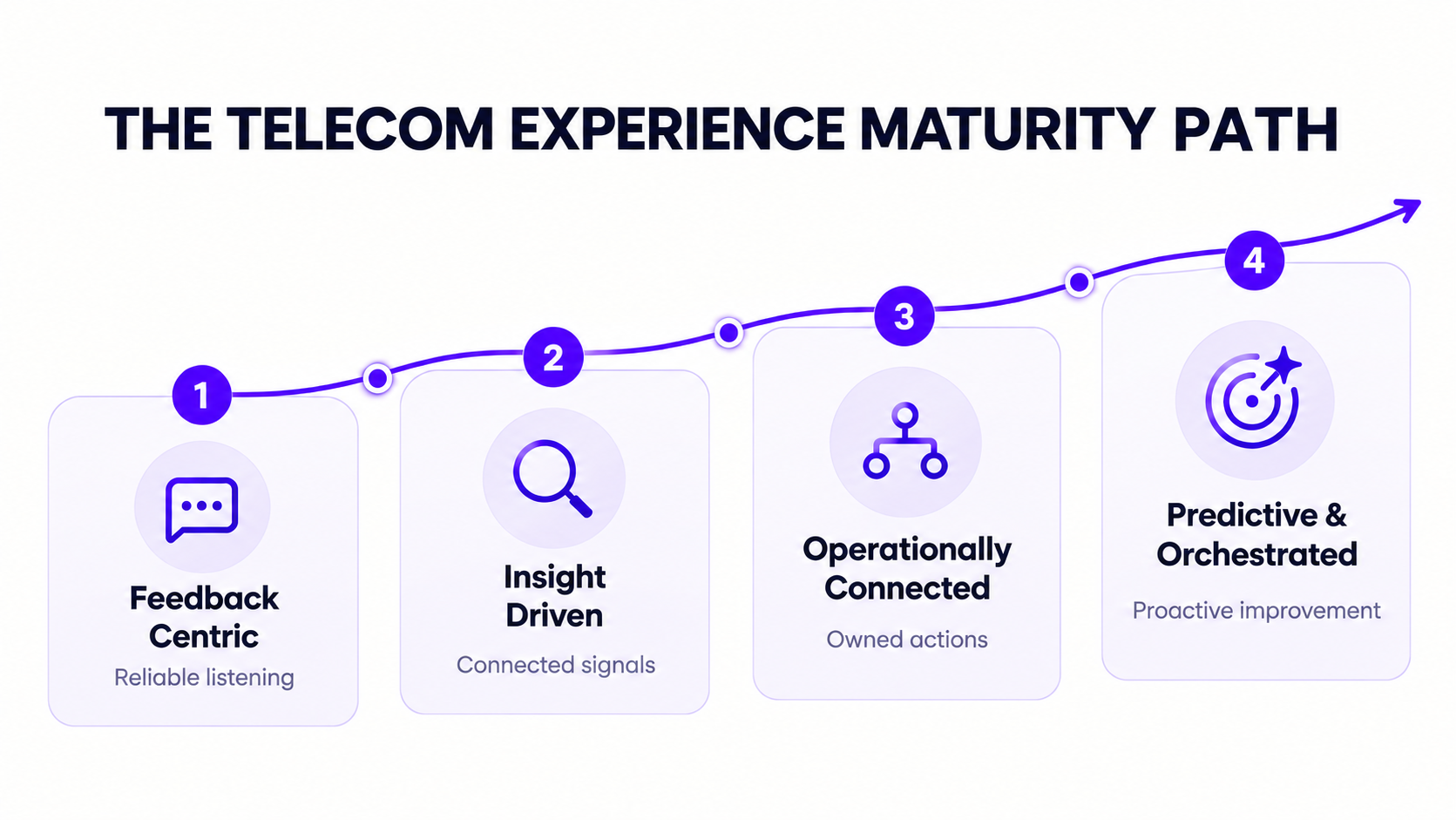
Telecom operators do not need to redesign every process at once.
For organizations with established VoC programs, transformation can begin with their existing measurements, platforms, and operational systems.
A gradual maturity model creates room for improvement while protecting program continuity.
Building the Foundation with Pisano
Modern telecom Experience Management requires a platform that can connect customer listening with enterprise operations.
Pisano brings survey management, omnichannel feedback collection, advanced text analytics, reporting, workflow automation, and case management into a connected Experience Management environment.
This enables telecom teams to collect feedback across digital and physical touchpoints, analyze customer experience at different organizational levels, and translate findings into structured operational actions.
Through enterprise integrations, customer feedback can also be enriched with relevant information from CRM, support, and operational systems.
For B2B programs, flexible organizational hierarchies and account structures support relationship measurement across stakeholders, business units, and enterprise customers.
Pisano's advanced experience analytics and Voice of Silent approach also support the broader direction of moving beyond conventional survey based measurement toward a more comprehensive understanding of customer experiences.
The platform is designed to support organizations at different stages of maturity, from establishing consistent listening programs to building more connected and proactive experience operations.
For telecom operators, this creates an opportunity to evolve their CX programs while maintaining the flexibility needed to support complex service environments.
The Future of Telecom CX Starts with a More Complete Picture
Connectivity will remain fundamental to the value telecom operators deliver.
But customers ultimately judge that connectivity through the experiences it enables.
They remember whether an important call worked, whether their service was activated on time, whether an invoice was understandable, and whether someone took responsibility when a problem occurred.
These experiences cannot always be explained by a network dashboard or a single satisfaction score.
The next evolution of telecom Experience Management lies in connecting the information organizations already possess with the experiences customers actually live.
It requires listening to customers who speak, recognizing meaningful signals from those who remain silent, understanding how operational performance affects perception, and ensuring that insight leads to action.
When these elements work together, customer experience becomes more than a measurement program.
It becomes a way to make better decisions across the organization, improve service delivery, strengthen relationships, and create lasting business value.