

Why customer experience ownership is becoming one of telecom's most important operational challenges, and what it takes to connect feedback, accountability, and measurable improvement across the enterprise.
A customer reports a poor broadband installation experience. The feedback reaches the CX team, while the installation record sits in a field service system. The contact center can see the complaint, but the technical team responsible for resolving the underlying problem works in a different environment.
The customer receives an apology. The survey response appears in a dashboard. The operational issue remains unresolved.
Every team has completed its part of the process, yet nobody has taken responsibility for the customer's complete experience.
This is a familiar challenge in telecommunications.
Telecom operators have developed sophisticated systems for monitoring network performance, managing customer interactions, measuring satisfaction, and tracking service delivery.
Many already operate mature Voice of Customer programs, collecting NPS, CSAT, and Customer Effort Score across numerous channels.
However, the ability to measure experiences does not automatically create the ability to improve them.
The problem becomes more complex as operators expand across fiber, mobile, digital services, enterprise connectivity, retail, and customer care.
Each business unit has its own priorities, systems, and performance indicators. Customer journeys cross these boundaries, often without a single team responsible for the overall outcome.
The result is an important gap between knowing what customers experience and ensuring that the organization acts on that knowledge.
For telecom leaders, the next stage of Experience Management requires a fundamental change in how customer experience is governed.
The central question is no longer simply whether the organization is listening. It is whether every important customer signal has a clear path to action, ownership, and measurable improvement.
The Ownership Gap in Telecom Customer Experience
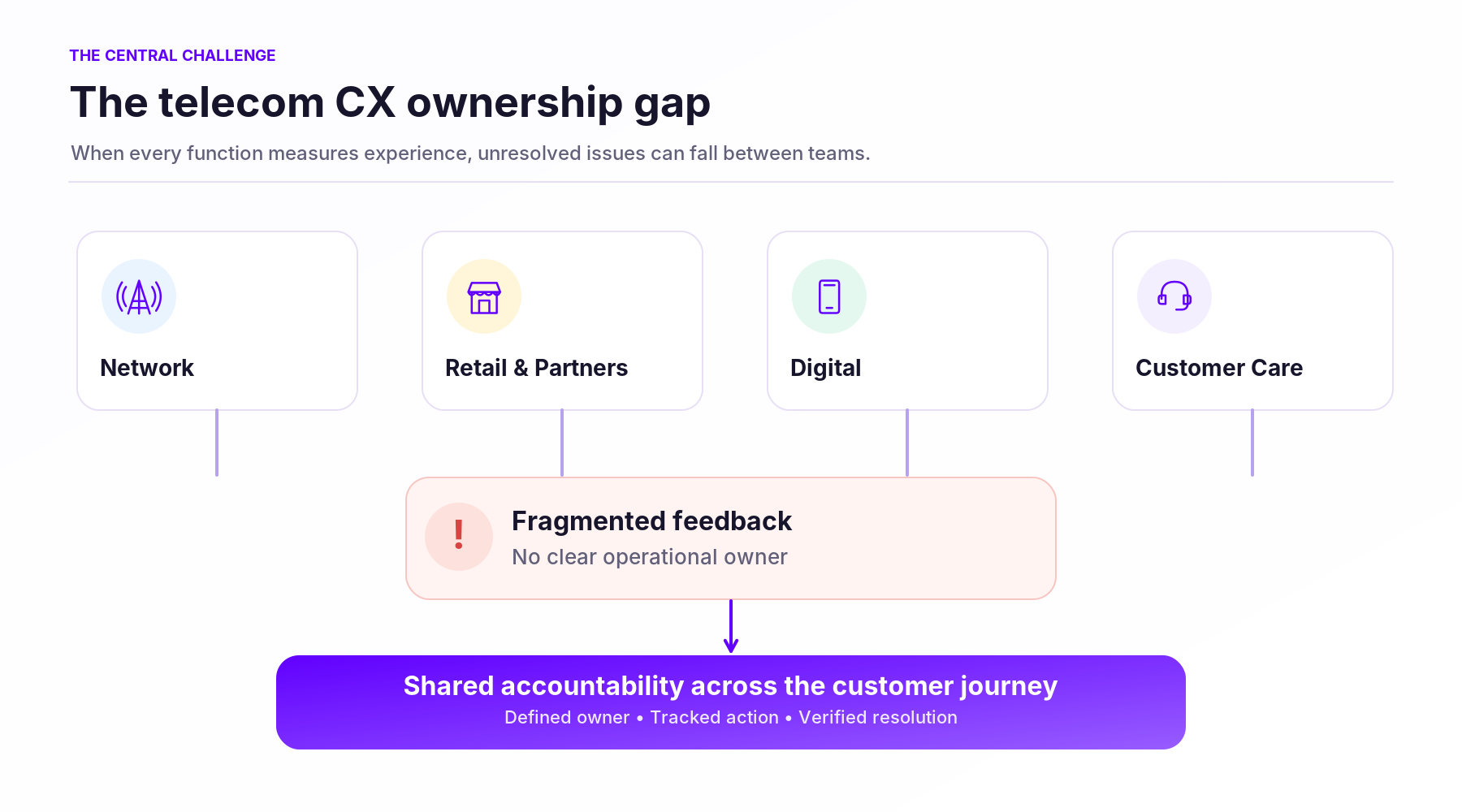
Customer experience is naturally shared across an organization.
Network teams influence service reliability. Digital teams shape application experiences. Retail and customer care teams manage customer interactions. Billing and commercial teams influence trust and perceived value.
This shared responsibility is unavoidable.
The difficulty begins when shared responsibility becomes unclear accountability.
Why Traditional VoC Programs Struggle to Drive Change
A conventional Voice of Customer program often follows a familiar process.
The organization collects feedback, analyzes scores, identifies dissatisfaction, and distributes reports to relevant departments.
Each department reviews the information according to its priorities.
A contact center may focus on handling time and agent performance. A network operations team may prioritize technical incidents. A digital team may concentrate on application performance and conversion.
These measures are valuable, but they do not necessarily reflect the complete customer journey.
Consider a customer reporting repeated difficulties activating a newly purchased mobile service.
The commercial transaction may have been successful. Technical provisioning may eventually reach completion. The contact center may close the related ticket.
Yet the customer has experienced an unnecessarily complicated activation journey.
Improving that experience requires coordinated action across functions rather than isolated improvements to departmental KPIs.
The same challenge appears in industry research.
TM Forum has highlighted how fragmented customer, product, network, and service data can prevent telecom operators from identifying the underlying causes of dissatisfaction and coordinating effective responses.
The opportunity is to establish a governance model in which customer experience insights can move across organizational boundaries without losing context or accountability.
Customer Experience Ownership Does Not Mean Centralizing Every Decision
A common misconception is that solving CX ownership requires giving one department responsibility for every customer problem.
For a large telecom operator, this would create another operational bottleneck.
A more effective approach establishes different levels of responsibility.
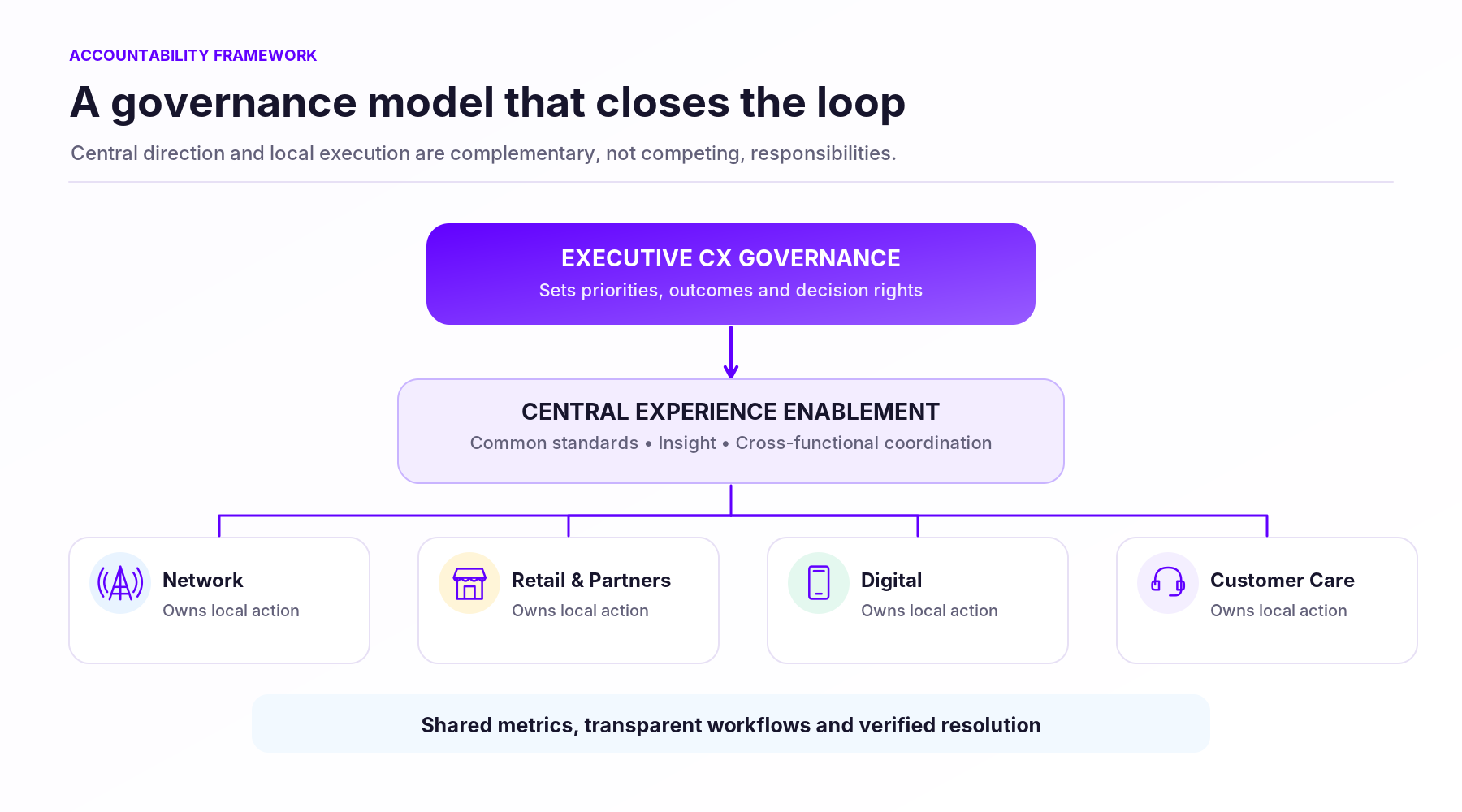
The central CX function owns the measurement framework, governance standards, and visibility into customer experience performance.
Business and journey owners are accountable for improving the experiences within their responsibility.
Operational teams own the actions needed to resolve specific issues.
Technology and data teams ensure that information can move securely and reliably between systems.
Executive leadership provides the authority needed to address problems that cross departmental boundaries.
The objective is to create a shared operating model in which responsibilities are visible and decisions can be traced to the people and teams accountable for them.
Building a Telecom CX Operating Model That Connects Listening with Action
A successful Experience Management program needs more than reliable feedback collection.
It requires an operating structure that connects customer signals with the people, processes, and systems capable of changing the experience.
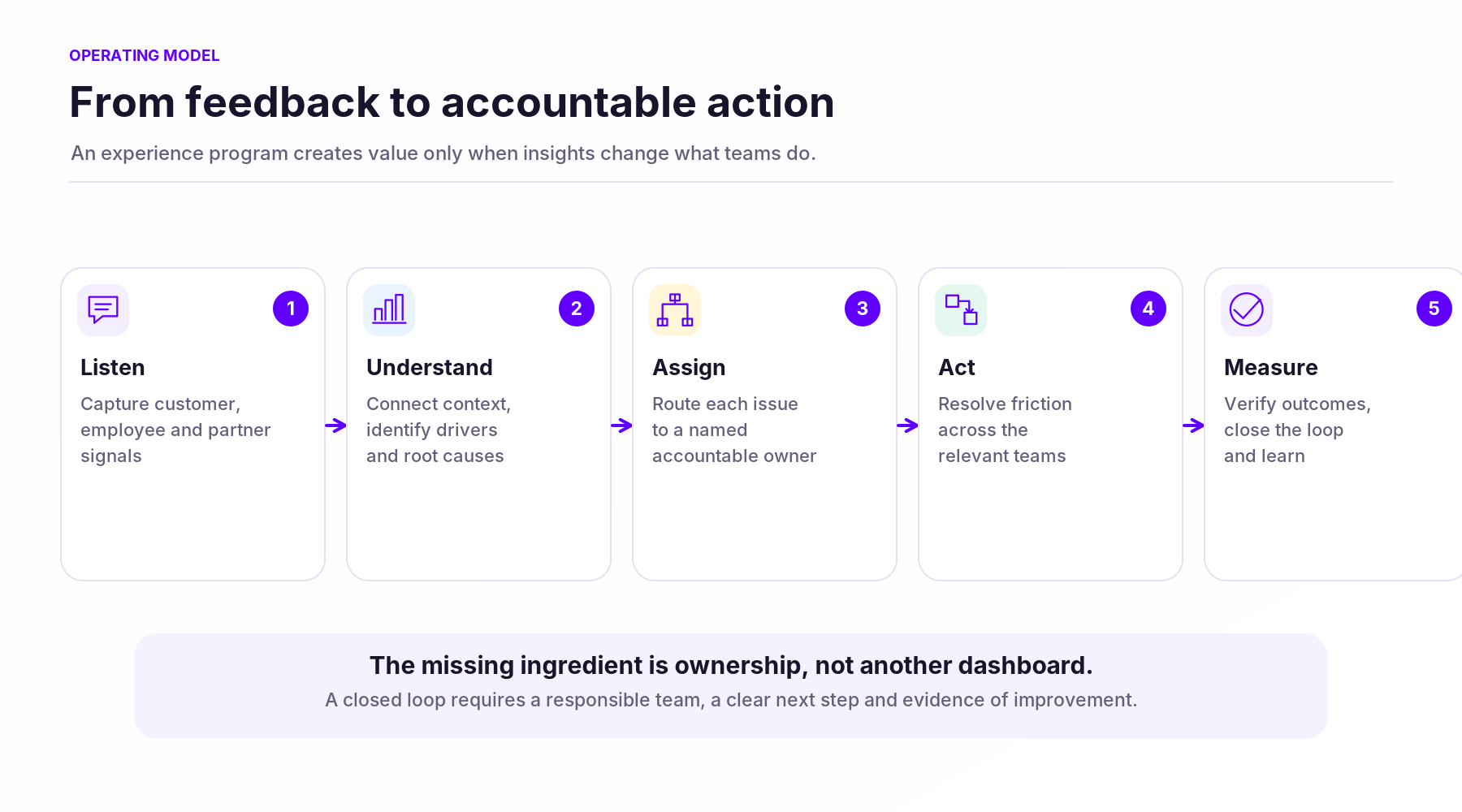
Several principles can help telecom operators establish this foundation.
1. Organize Experience Management Around Customer Journeys
Telecom organizations often structure their listening programs around channels.
They measure contact center satisfaction, retail satisfaction, digital satisfaction, and network satisfaction independently.
While channel level measurement is useful, customers experience services through journeys that often involve several channels.
A broadband installation may begin on a website, continue through order processing and field service, and end with a support interaction.
A business service renewal may involve an account manager, procurement discussions, technical service reviews, and several operational teams.
Measurement should therefore preserve the context of the entire journey.
A useful starting point is identifying the customer moments where dissatisfaction has the greatest operational or commercial consequences.
For each journey, organizations should define what success means for the customer, which teams influence the outcome, and which operational events should trigger feedback collection.
This creates a stronger foundation for improving experiences than measuring every interaction independently.
2. Capture Feedback in the Context of the Service Event
Customer feedback becomes more useful when the organization understands what happened before the customer responded.
A low satisfaction score after an installation tells the CX team that something went wrong.
When that feedback also contains the installation date, appointment history, service type, region, and relevant interaction reference, the organization has a much better opportunity to understand the problem.
This requires contextual listening.
Surveys can be triggered by service events such as completed installations, support interactions, billing activities, and digital transactions.
Depending on customer preferences and channel eligibility, invitations may be delivered through SMS, email, mobile applications, web interfaces, or assisted channels.
For enterprise relationships, scheduled interviews and relationship surveys may be more appropriate than frequent transactional invitations.
The most effective channel is the one that reaches the relevant customer at an appropriate moment without creating unnecessary survey fatigue.
Contact frequency policies, consent management, and suppression rules should therefore form part of the listening strategy.
The objective is to collect feedback that can be understood and acted upon, rather than maximize the number of survey invitations.
3. Connect Experience Data Without Replacing Every Existing System
Large telecom operators already have extensive technology ecosystems.
Customer information may exist in CRM systems. Service incidents are managed through ticketing platforms. Network information is monitored in operational environments. Business intelligence and historical analysis may be concentrated in enterprise data warehouses.
Replacing these systems is rarely necessary to establish a more connected Experience Management program.
Instead, operators should identify how experience information needs to move between them.
For example, a negative response following technical support may need to initiate a service recovery action in an existing ticketing environment.
A recurring complaint about activation failures may need to be analyzed alongside order management data.
Feedback from an enterprise account may need to appear in the relationship management view used by the responsible account team.
A practical architecture preserves the responsibilities of existing systems while introducing a connected layer for experience intelligence and operational action.
The enterprise data warehouse can continue supporting historical and organization wide analytics.
Experience management processes can focus on collecting relevant signals, making them accessible to the appropriate teams, and initiating actions when necessary.
Secure APIs, event notifications, and governed data transfers can support these connections.
The key architectural question is:
Can an experience signal move from the moment it is captured to the team responsible for resolving it, with enough context to support an informed decision?
If the answer is unclear, the integration strategy deserves more attention.
4. Make Closed Loop Management a Defined Operational Process
Closing the feedback loop is frequently discussed as a CX best practice.
However, different organizations use the term to describe different activities.
For some, it means acknowledging customer feedback.
For others, it means assigning complaints or conducting follow up calls.
A comprehensive closed loop process should go further.
When feedback indicates a problem, the organization should establish who owns the issue, which actions are required, when the customer should receive an update, and how resolution will be verified.
This is commonly referred to as the Inner Loop.
The Outer Loop focuses on recurring problems that require structural improvement.
For example, repeated complaints about confusing invoices should eventually lead to an investigation into billing communication and design.
Repeated dissatisfaction following technician visits may reveal scheduling, training, or process issues.
The objective is to reduce the likelihood of the same problem affecting future customers.
Both levels require clear ownership.
A complaint can be resolved for an individual customer while the underlying operational issue remains.
Telecom CX programs need mechanisms for addressing both.
5. Establish Governance That Works Across the Enterprise
A customer experience operating model must accommodate the organizational complexity of telecommunications.
Different countries, business units, service categories, and customer segments may require different measurement approaches.
At the same time, leadership needs consistent definitions and reliable consolidated reporting.
This requires a balance between centralized standards and local operational flexibility.
A practical governance model can assign responsibilities as follows.
This structure allows CX to remain a shared enterprise responsibility while ensuring that individual outcomes have identifiable owners.
Technology can support governance through organizational hierarchies, permissions, workflow rules, and audit records.
However, technology cannot compensate for responsibilities that have never been defined.
The operating model must come first.
AI Can Accelerate Insight, but Ownership Still Determines the Outcome
Artificial intelligence introduces valuable opportunities for telecom Experience Management.
AI powered text analytics can categorize large volumes of customer comments, identify recurring themes, and highlight changes in sentiment.
A customer care manager may quickly identify an increase in complaints about a recently introduced billing process.
A regional operations manager may discover that installation dissatisfaction is concentrated around specific service conditions.
An enterprise account team may identify recurring support problems affecting strategic customers.
AI can reduce the time required to interpret information and make these patterns more visible.
However, identifying a problem is only the beginning.
The organization still needs to determine who will investigate it, which action is appropriate, and how the result will be evaluated.
For this reason, AI should operate within a governed experience management framework.
Models need appropriate data access, validation, and monitoring. Recommendations should remain traceable to supporting evidence. Sensitive or consequential decisions require suitable human oversight.
As capabilities mature, organizations may introduce anomaly detection, predictive risk analysis, and more advanced workflow assistance.
These tools become most valuable when they strengthen an already functioning operational process.
The real opportunity lies in reducing the time between detecting an experience problem and taking effective action.
Five Illustrative Telecom Scenarios: Different Ecosystems, Shared Ownership Challenges
No two telecom operators have identical operating environments.
Some manage several service categories within one country. Others operate across multiple markets and subsidiaries.
Some are replacing legacy Experience Management systems. Others need stronger governance across existing platforms.
The following illustrative scenarios explore how different telecom ecosystems can address these challenges.
They are hypothetical examples designed to demonstrate transferable operating principles, rather than representations of specific customer implementations or verified results.
Scenario 1: A Converged Operator Connecting Customer and Employee Experience
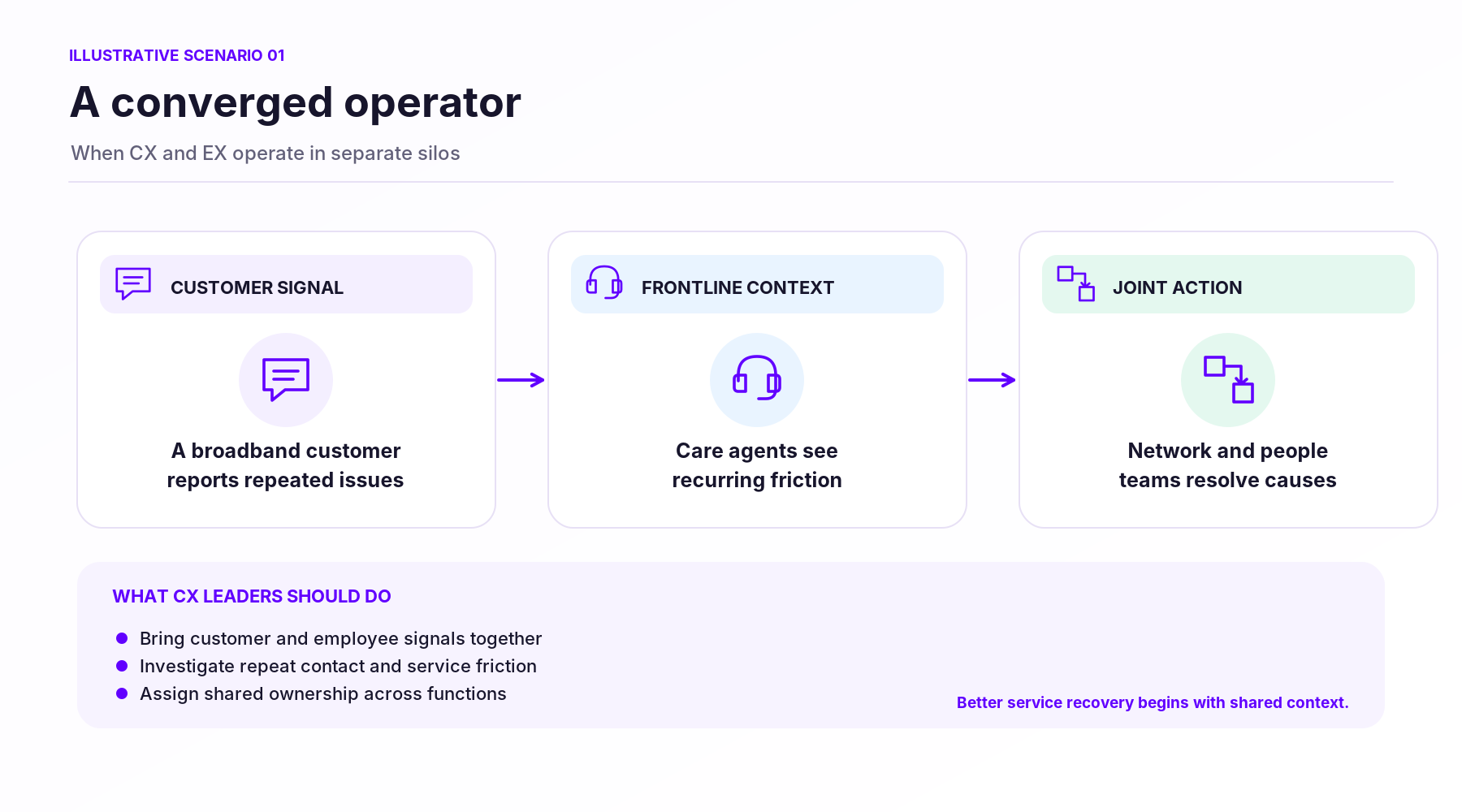
Imagine a telecom operator providing mobile connectivity, home broadband, and enterprise services through an extensive retail and contact center network.
The organization collects customer feedback after support interactions, retail visits, service installations, and digital transactions.
It also collects employee feedback across operational teams.
However, the two programs operate separately.
Customer dissatisfaction may reveal repeated service failures, while employees report difficulty accessing the information needed to resolve those failures.
The organization has evidence from both perspectives but lacks a consistent way to examine their relationship.
A possible approach
The operator establishes a shared Experience Management governance framework while preserving appropriate boundaries between customer and employee information.
Customer feedback is connected to the relevant interaction, channel, and operational process.
Employee feedback helps identify internal obstacles affecting service delivery.
For example, declining satisfaction after technician appointments may coincide with employee feedback about scheduling difficulties or incomplete service information.
The organization can investigate whether these issues share an operational cause.
Critical customer responses can also initiate follow up actions within existing customer service systems, giving teams a structured way to respond.
The potential value
The operator gains a more complete understanding of how internal working conditions influence customer outcomes.
CX and EX remain distinct disciplines, but their insights can support coordinated improvements in service delivery.
Scenario 2: An International Connectivity Provider with Fragmented Customer Journeys
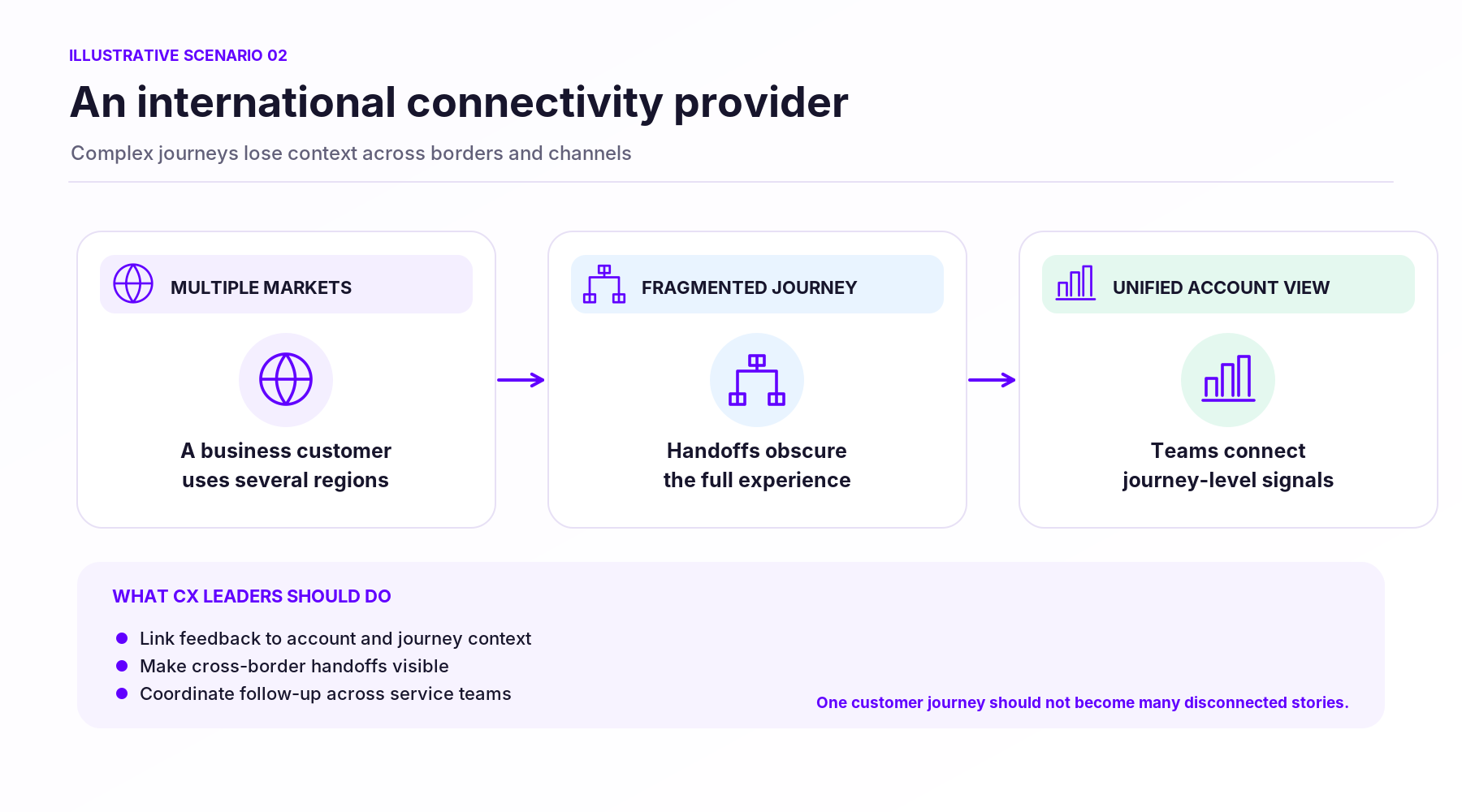
Consider a telecom provider serving customers who regularly travel across borders.
Customers purchase roaming packages, activate services through mobile applications, use partner networks, and contact support from different countries.
The journey involves multiple digital and operational systems.
A customer may purchase a roaming package before traveling, experience an activation problem after arrival, contact support, and later receive a feedback invitation.
If these interactions are recorded independently, the operator may understand each event without recognizing the complete experience.
A possible approach
The provider introduces consistent journey and interaction identifiers that connect customer feedback with relevant service events.
Feedback invitations can be triggered at meaningful moments, such as roaming activation or the resolution of a service issue.
Multilingual listening supports different customer groups, while contact policies prevent excessive communication during travel.
Customer feedback is linked with the operational context required to investigate problems.
The architecture can operate within a secure private hosting environment when infrastructure or governance requirements make this appropriate.
The potential value
The organization can evaluate international service journeys with greater continuity.
Instead of investigating each support interaction independently, teams can examine how different events influence the overall experience and coordinate service recovery across responsible functions.
Scenario 3: A Multimarket Telecom Group Migrating Years of Experience Data
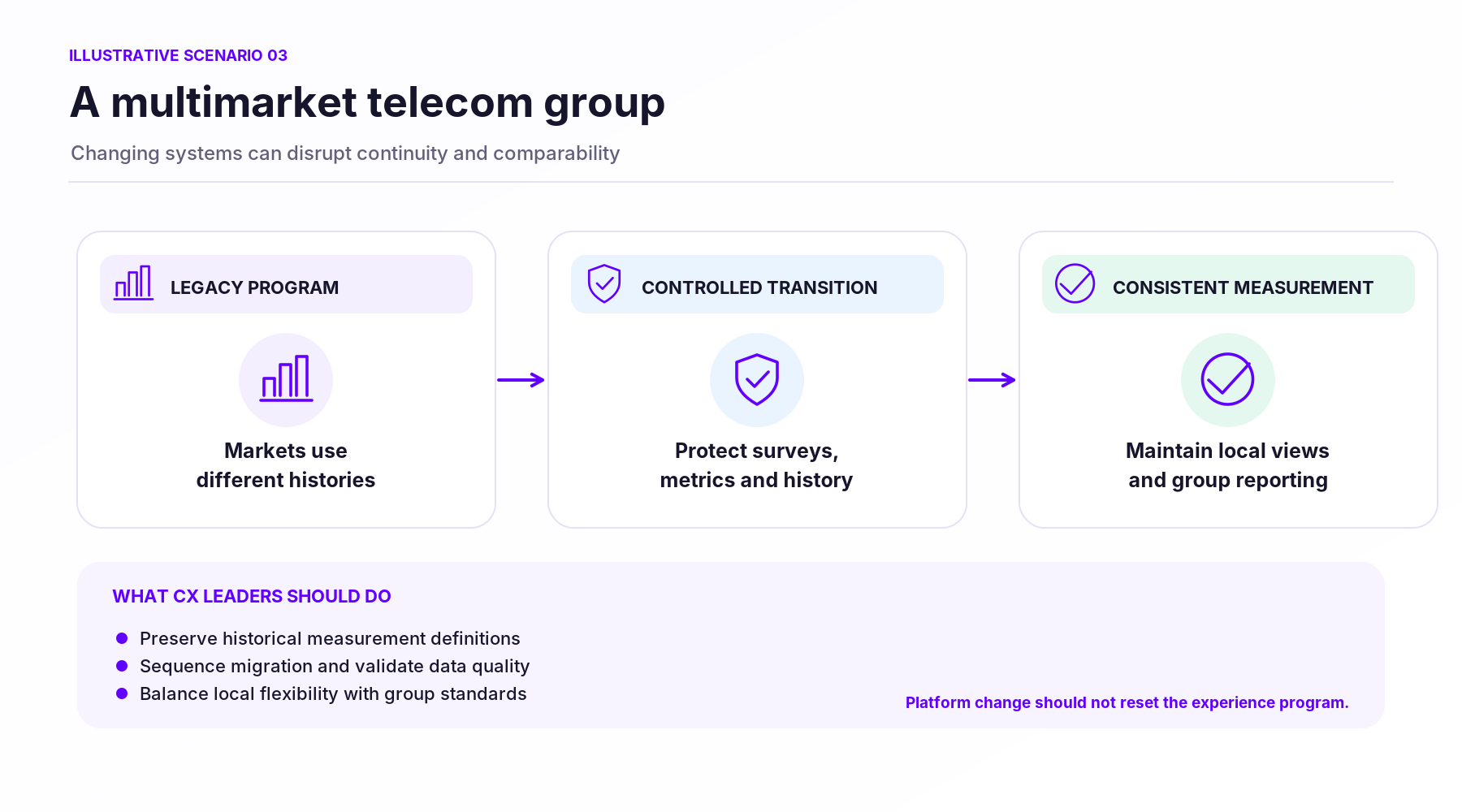
Imagine an international telecom group operating across numerous markets.
Over several years, the group has developed extensive customer listening programs.
Different teams manage large volumes of survey invitations, historical feedback, multilingual questionnaires, and recurring executive reports.
The existing Experience Management environment is approaching replacement.
The migration presents a significant operational challenge.
Historical data must remain useful. Important satisfaction metrics need to remain comparable. Local teams cannot afford prolonged interruptions to established listening programs.
A possible approach
The organization begins with an audit of its existing measurement framework.
Survey structures, scoring rules, reporting calculations, customer attributes, data retention policies, and integration dependencies are documented.
The group establishes a common taxonomy while allowing necessary local variations.
Historical records are migrated through controlled processes, with reconciliation of record counts, fields, and scoring calculations.
A phased transition allows selected journeys and markets to be validated before broader deployment.
Parallel reporting can help identify methodological differences that might otherwise be mistaken for changes in customer satisfaction.
Multilingual analytics and governed access can then support consolidated reporting across the group.
The potential value
A platform transition becomes an opportunity to simplify years of accumulated complexity.
The organization can preserve valuable historical information while establishing more consistent measurement and governance for future expansion.
Scenario 4: A Federated Telecom Group with Different Local CX Practices
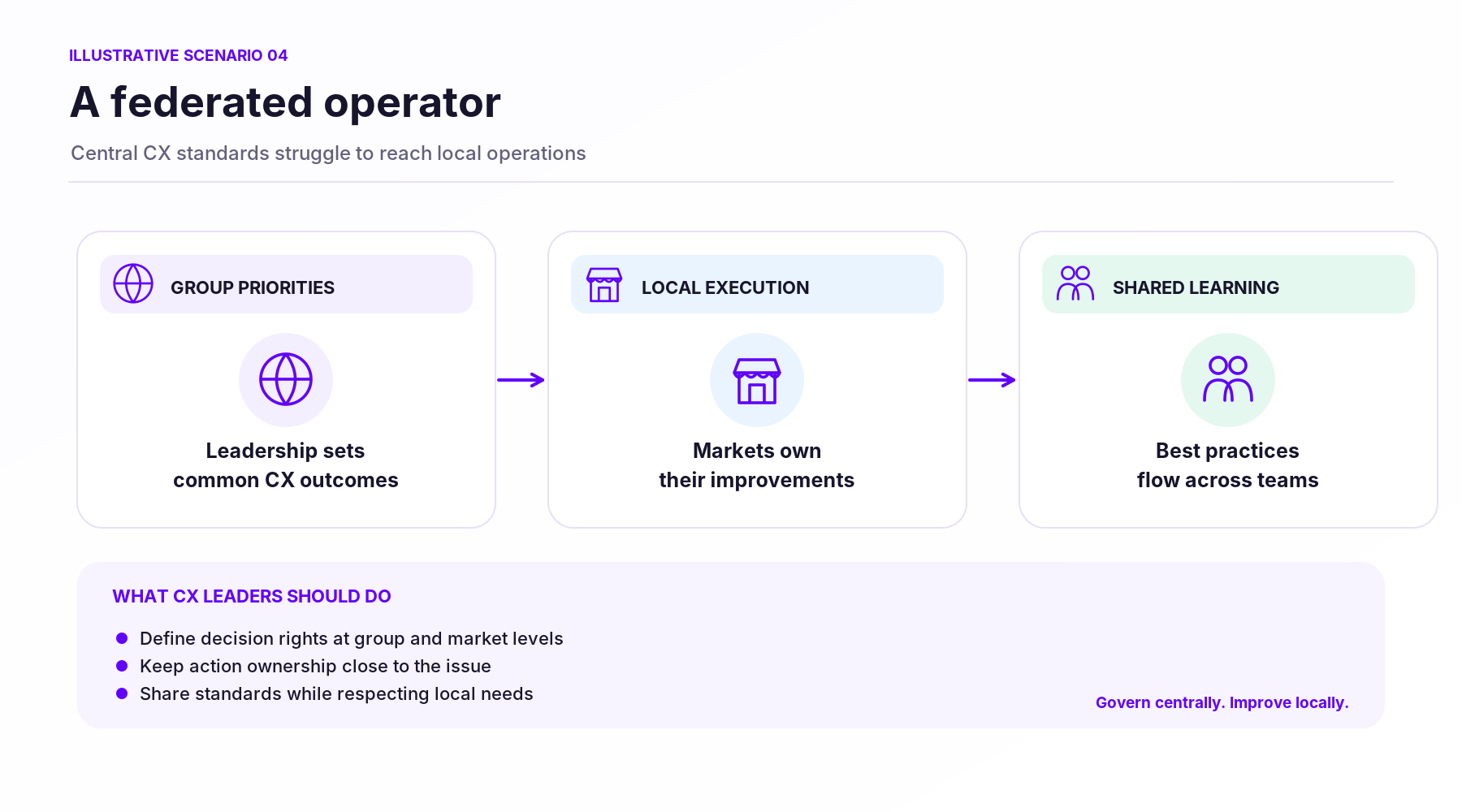
Consider a group of national telecom operating companies.
Each business has developed its own customer listening processes.
Some teams use several survey tools. Others rely heavily on external research or manually distributed reports.
Local management teams understand their customers, but the group struggles to establish a consistent view of performance.
Even when all companies report NPS, differences in survey timing, sampling, and calculation rules may limit comparability.
Operational actions are also managed locally, making it difficult to identify successful improvement practices that could benefit the wider group.
A possible approach
The group creates a common Experience Management framework covering measurement definitions, governance principles, and reporting structures.
Each operating company retains the flexibility to address local journeys and market requirements.
Organizational hierarchies and access permissions provide appropriate visibility for frontline managers, local leadership, and group executives.
The group defines common standards for escalation, follow up, and improvement tracking.
Local CX teams can then compare recurring challenges and share effective practices without forcing every market into identical operational processes.
The potential value
The group creates a balance between local ownership and enterprise consistency.
Customer experience becomes easier to govern across operating companies, while successful improvements can be identified and adapted for other markets.
Scenario 5: A National Telecom Operator with Strict Infrastructure Requirements
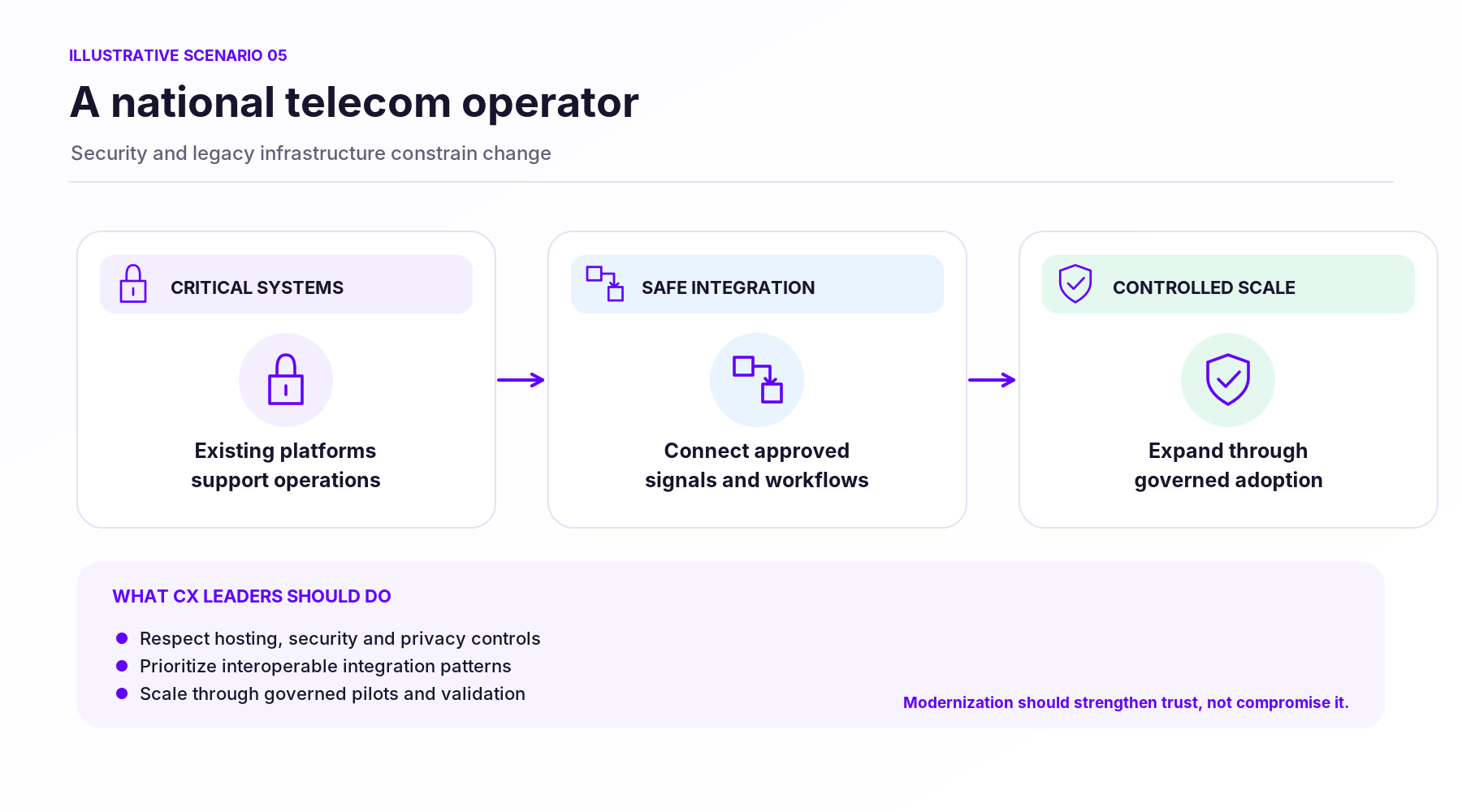
Imagine a major national telecom operator providing mobile, fixed broadband, enterprise connectivity, and digital services.
The organization operates a mature technology environment with strict security, integration, and data governance requirements.
Its Experience Management program includes relationship surveys, transactional feedback, digital listening, and consumer research.
Different programs support different business objectives, but their results remain difficult to connect.
The operator wants to improve program consistency without disrupting critical infrastructure or transferring sensitive customer data into an unsuitable hosting environment.
A possible approach
The organization establishes a central governance framework covering its major listening programs.
A secure deployment architecture is selected according to technical, regulatory, and data residency requirements. Where appropriate, this may include private cloud or on premises infrastructure.
Relationship surveys measure broader customer perceptions, while transactional feedback remains connected to specific service events.
Web and mobile listening help identify friction in digital journeys.
Ad hoc research provides deeper understanding of customer needs and service perceptions.
Integration with existing data and operational systems allows findings to inform service recovery and improvement decisions.
The potential value
The operator gains greater consistency across different types of customer research and experience measurement while respecting its infrastructure requirements.
A shared framework can improve visibility, accountability, and collaboration without requiring the organization to abandon established enterprise systems.
A Platform Migration Can Become a Strategic Reset for CX Ownership
For telecom operators with mature listening programs, replacing an Experience Management platform is rarely a simple software exercise.
Existing surveys may support important executive KPIs. Historical data may inform years of performance analysis. Operational workflows may depend on integrations that are not immediately visible to the central CX team.
A rushed migration can create reporting inconsistencies, disrupt customer listening, or introduce new operational gaps.
However, a well structured transition provides an opportunity to improve the underlying program.
The first step should be understanding what currently exists.
Organizations need a reliable inventory of surveys, channels, scoring methodologies, integrations, user roles, workflows, and reporting requirements.
The second step is separating essential continuity requirements from future improvements.
Critical journeys and metrics should remain stable during transition.
New capabilities can then be introduced in manageable stages.
The third step is clarifying ownership.
Who approves measurement changes? Who validates historical data? Who signs off on operational workflows? Who is responsible for adoption after launch?
These questions matter as much as the technical migration itself.
A new Experience Management environment should strengthen organizational accountability rather than reproduce every weakness of the previous operating model.
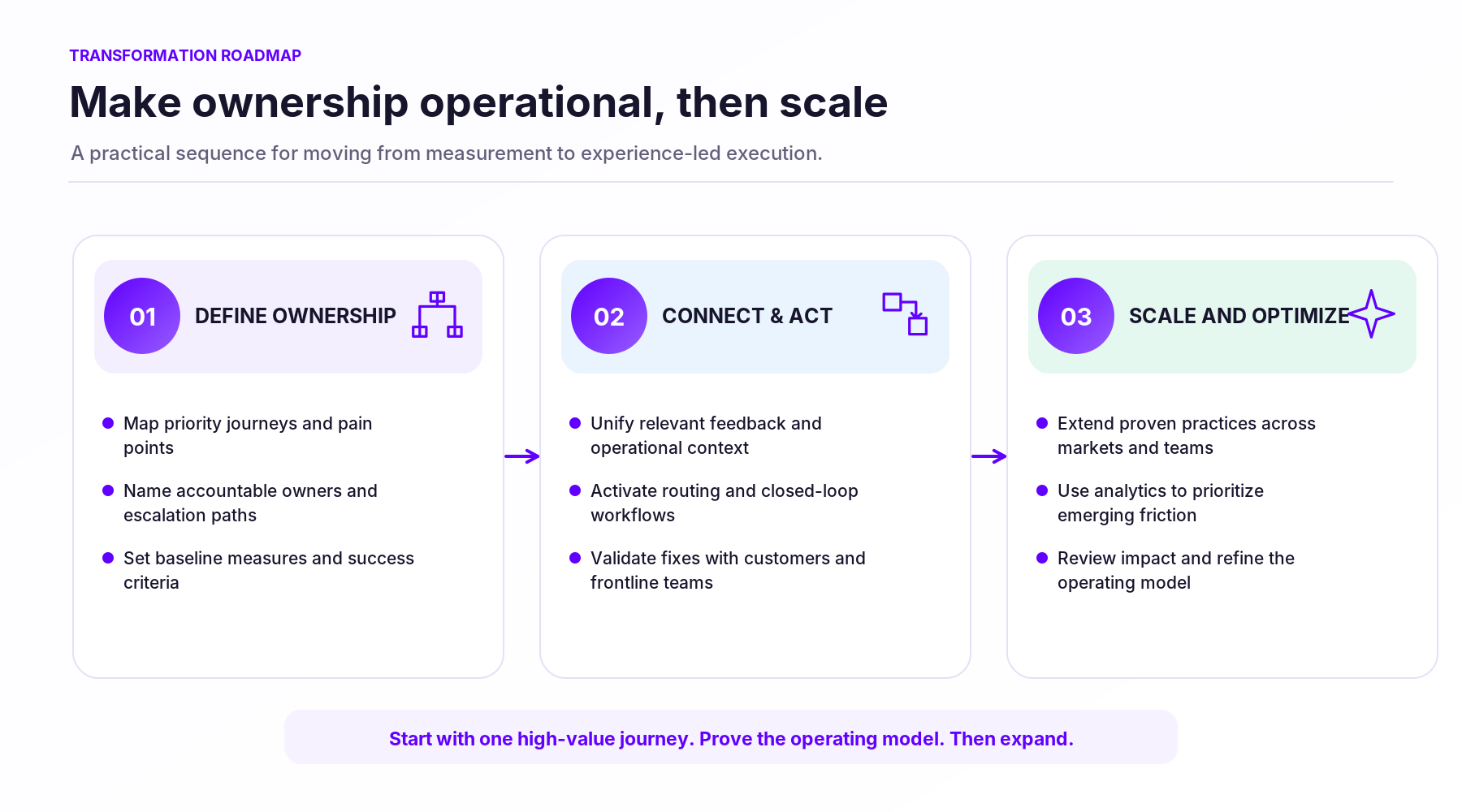
What the First 12 Months of Transformation Could Look Like
A realistic transformation program should prioritize operational adoption and measurable results.
The following roadmap illustrates how an established telecom operator might approach its first year.
Measuring Success Beyond the Number of Surveys Collected
A successful telecom Experience Management program should be evaluated through the changes it enables.
Traditional listening metrics remain important.
Response rates, survey completion, and coverage help organizations understand the reliability of their feedback programs.
NPS, CSAT, and Customer Effort Score help measure different aspects of customer perception.
However, operationally connected programs need additional indicators.
Accountability and Execution
What proportion of critical feedback reaches an assigned owner?
How quickly are cases created and acknowledged?
How many customer issues are resolved within agreed service targets?
How often do resolved problems recur?
Operational Improvement
Have repeated complaints decreased?
Are customers contacting support less frequently about the same issues?
Have activation delays, failed digital transactions, or installation problems become less common?
Organizational Adoption
Are business units using experience insights during regular operational reviews?
Do local managers understand their responsibilities?
Are improvement initiatives tracked through completion?
Business Impact
Are improvements associated with lower cost to serve, stronger customer retention, or healthier enterprise relationships?
These effects should be assessed using appropriate baselines and, where possible, comparisons that help distinguish CX interventions from unrelated changes.
Together, these measures provide a more complete view of the program's contribution.
An organization may collect fewer survey responses after improving its contact policies while making better operational decisions from the feedback it receives.
Likewise, an increase in detected complaints may initially indicate improved visibility rather than deteriorating service.
Success should therefore be judged by the quality of the information, the effectiveness of the response, and the resulting customer and business outcomes.
The Next Stage of Telecom CX Belongs to Organizations That Can Act Together
Telecommunications will continue to become more complex.
Operators will manage increasingly diverse connectivity services, digital experiences, business relationships, and technology ecosystems.
AI will expand the amount of information organizations can analyze and the speed at which they can detect emerging problems.
Yet the fundamental challenge will remain remarkably human.
Someone must understand the issue.
Someone must take responsibility.
Someone must ensure that the customer's experience improves.
A mature Experience Management program makes these responsibilities clear and gives teams the information they need to fulfill them.
It connects centralized governance with local action, customer perception with operational context, and individual service recovery with structural improvement.
Most importantly, it makes customer experience a shared business discipline with measurable accountability.
Telecom operators already know how to measure network performance, customer interactions, and satisfaction.
Their next competitive advantage may come from bringing those measures together and ensuring that the organization acts on what they reveal.
The question for telecom leaders is simple: When your customers tell you something is wrong, does your organization know who owns making it right?